
Where San Bruno's Previous Residents Surface
One address can leave traces in several time layers. The era table leads with sources that are actually documented for San Bruno and marks the access gap at each layer. It gives previous residents research a date-aware starting point. A deed proves a recorded transaction. A directory shows a listed subscriber. A census shows a household at an enumeration moment. A permit shows work and named project parties. None should be stretched into a complete occupancy record.
| Source | Years it covers | Where held | What it shows |
|---|---|---|---|
| RecorderWorks party index | 1985-present name index | San Mateo County ACRE | Recorded parties, instruments, dates, and document numbers |
| Known pre-1985 instruments | Earlier records when number or date is known | RecorderWorks or Recorder counter | Older legal documents and chain clues |
| Polk telephone directories | 1950, 1953, 1955, 1959 | San Bruno Library | Listed subscriber and address snapshot |
| Federal census | Public through 1950 under 72-year rule | NARA and partners | Household, age, birthplace, occupation, and enumeration address |
| San Bruno Herald | 1920-2004, potentially incomplete | Library newspaper archive | Transfers, deaths, social notices, and local events |
| Clipping files and Sanborn maps | 1938-2007 clippings; map dates unspecified | Library History Collection | House, neighborhood, footprint, and address continuity clues |
| Permits and plans | MGO from July 1, 2024; older eTRAKiT and OnBase files | San Bruno Building Division | Project, inspection, contractor, and work chronology |
The best sequence starts with a current APN, then crosses the 1985 recorder boundary, the 1950s directory dates, and the 1950 census release. Gaps are part of the answer. A missing page or name is not proof that no one lived at the address.
San Bruno Previous Residents Start With APN
Search the county GIS by address or known APN and record the parcel polygon, situs context, city and ZIP layers, subdivision or survey references, and adjacent lots. The APN is more stable than a formatted street line. It can bridge the map to the assessor, a deed's legal description, permits, and an older address clue. The county viewer does not supply a verified public owner-name search or a buffer tool, so a house-history search should use visual parcel selection.
San Bruno's early east grid, post-1950 western hillside subdivisions, and historical neighborhood labels can make the same land appear under different descriptions. San Bruno Road is reported in historical-resource work as corresponding to today's San Mateo Avenue, but each parcel still needs map and deed confirmation. Preserve the old wording in the notes instead of replacing it silently. This is how previous residents research avoids turning a historic street label into a false parcel. The ACRE real-estate fraud alert page is the source for the property-privacy capture below.
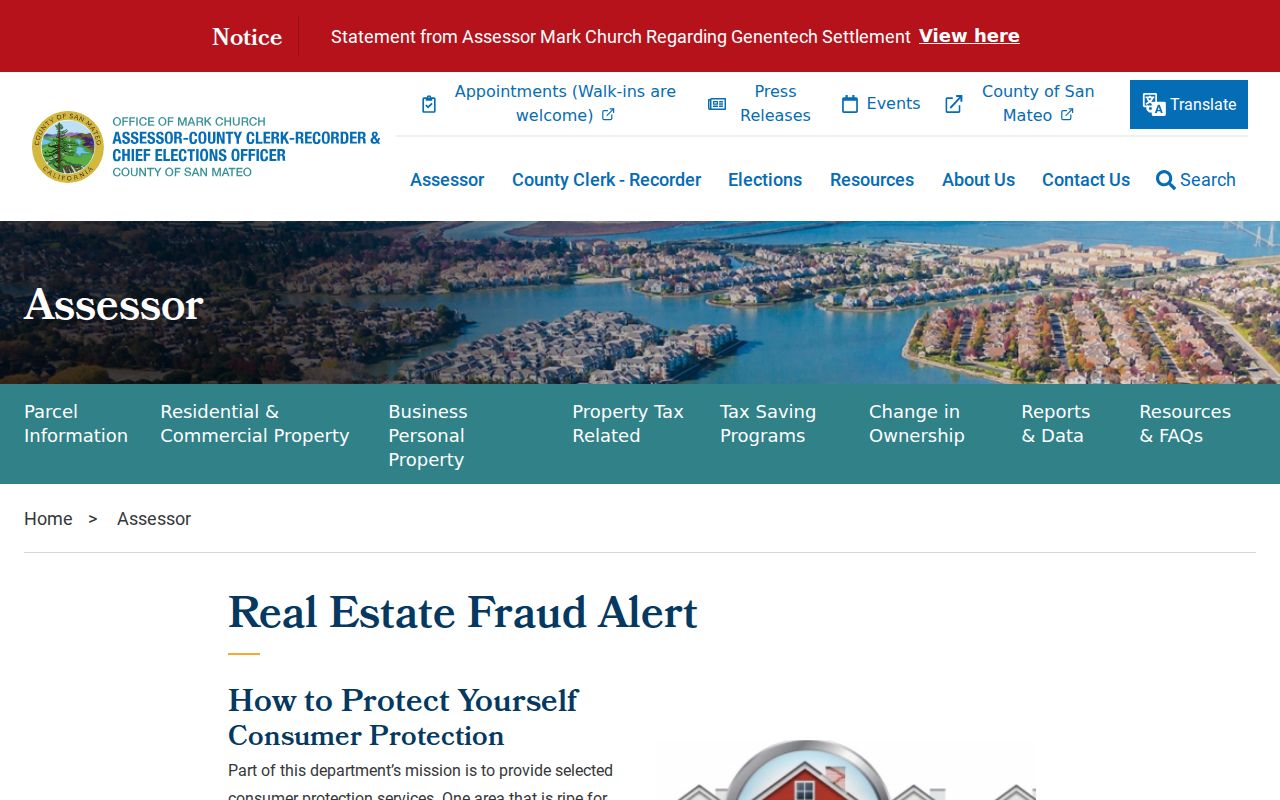
The ACRE real-estate fraud alert capture explains why a public property search may suppress owner names online. That privacy design makes APN, document number, date, counter access, and copy procedures especially important for a San Bruno house history.
- Grantor
- The party conveying an interest in a recorded instrument.
- Grantee
- The party receiving an interest in that instrument.
- Chain of title
- A sequence of recorded transfers tied to the same land description.
- Legal description
- The formal description of land in a deed, which can outlast a street-number format.
Find a San Bruno Previous Owner
Use the current APN and acquisition window to identify the present title transaction. In RecorderWorks, search the current grantee around the date and narrow by deed type. Read the document itself when available. Note the document number, recording date, grantor, grantee, legal description, APN, and any later release or reconveyance. The title party is a starting point for the backward trail, not a conclusion about the people who occupied the house.
San Mateo County's RecorderWorks name index begins in 1985. The RecorderWorks entry point supports name, document number, book and page, recording date, document type, map, and predefined modes. A search by street address is not the portal's documented route. When a known older document number or date exists, earlier instruments may be retrieved, but pre-1985 name research goes to the counter or index books.
Search the current grantor as a prior grantee only after the legal description matches. Names alone can join two different properties or two unrelated people. A previous residents trail needs the same land description at each step. Keep a copy or office reference for each link in the chain.
San Bruno Previous Resident Grantor Chain
A backward deed chain is a repeated, controlled process. The current grantee's deed names a grantor. That grantor may have received the property earlier, but only a matching legal description and APN make the connection persuasive. If the description changes, check maps, subdivision documents, lot-line adjustments, or a recorded survey before moving on. A transfer can include a trust, business, estate, or multiple parties, so role labels matter.
- Record the current deed number, recording date, grantor, grantee, instrument type, and land description.
- Search the grantor as a grantee in an earlier date band and limit by relevant deed types.
- Compare the APN, legal description, map reference, and address language before accepting the link.
- Repeat until the online party-name boundary is reached, then move to the counter and index books.
- Overlay each title event with permits, directories, newspapers, probate, and census evidence before describing a previous resident.
Note: Ownership chain and occupancy trail are parallel lines; they meet only when a separate source supports the household connection.
San Bruno's 1985 Recorder Boundary
The 1985 cutoff is the key numbers story in a San Bruno house history. RecorderWorks provides party-name indexing from 1985 forward, but a contradictory help note mentions documents older than 1982. The live range and explicit portal statement support using 1985 as the safe name-search boundary. For previous residents, that cutoff marks the switch from online party names to counter research. Do not claim that the older note proves a pre-1985 name index.
Earlier records still have access channels. Known document numbers and recording dates can help retrieve an older instrument. The Recorder's counter and index books support pre-1985 name work. FamilySearch also holds a California, San Mateo County Records, 1851-1991 collection with 1,594,995 browsable images of marriage intentions, naturalizations, deeds, patents, homesteads, and military discharges. Only marriage intentions are indexed, and some images require a free login or affiliate access. Use that collection to bridge known older books, not as a replacement for the county's current title index. The recorded-document copy instructions are the source for the request capture below.
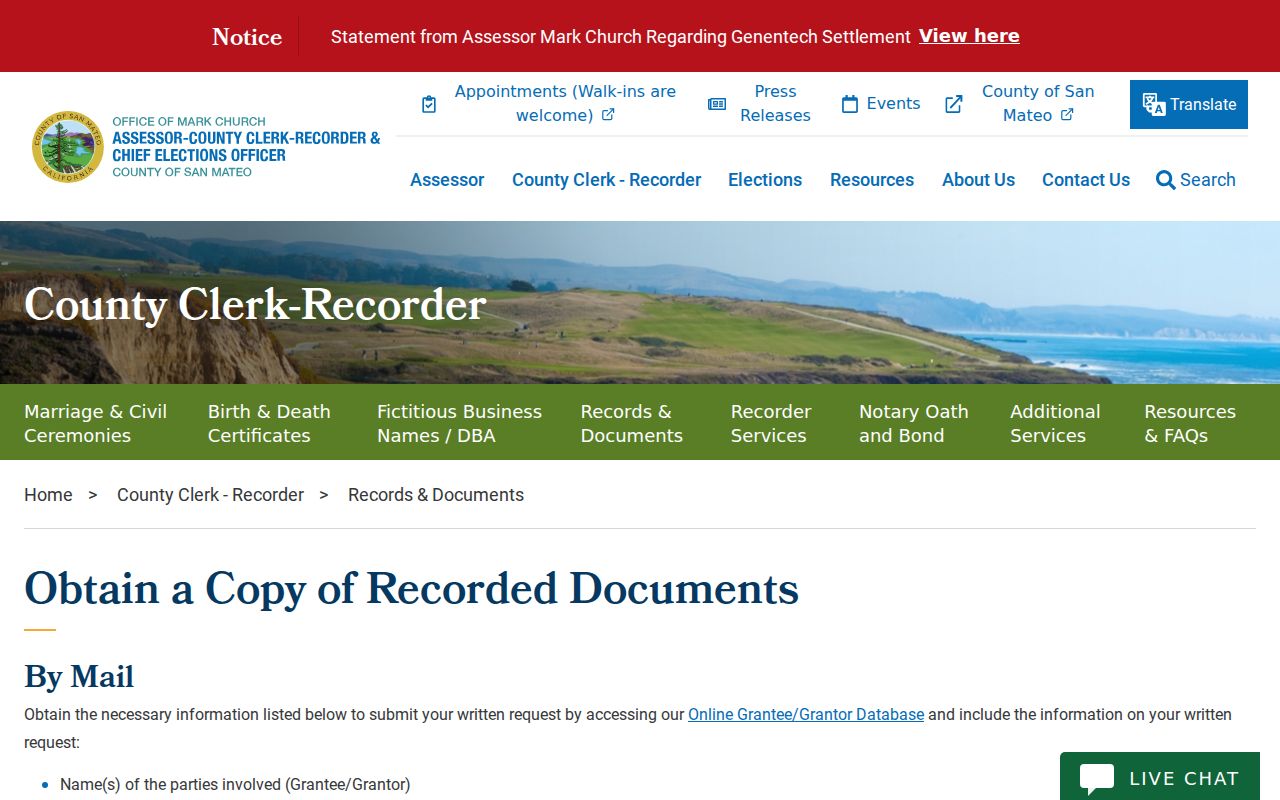
The recorded-document copy-request capture shows the county fallback when an index result needs an actual document. A mail request should include parties, document type, recording date, document number, page count, payment, and a return envelope.
San Mateo Recorder Copy Route
ACRE lists the Recorder and customer service desk at 555 County Center, First Floor, Redwood City. Office hours are Monday through Friday, 8 a.m. to 5 p.m., excluding holidays, with appointments encouraged and walk-ins subject to time and space. Recorder, vital, and copy questions use 650-363-4500; the appointment line is 650-599-1713. Mail payments are limited to checks drawn on a U.S. bank, while the counter accepts cash, check, Visa, or Mastercard.
The ACRE contact page is the right place to recheck the division, phone, email, and hours before sending a copy request.
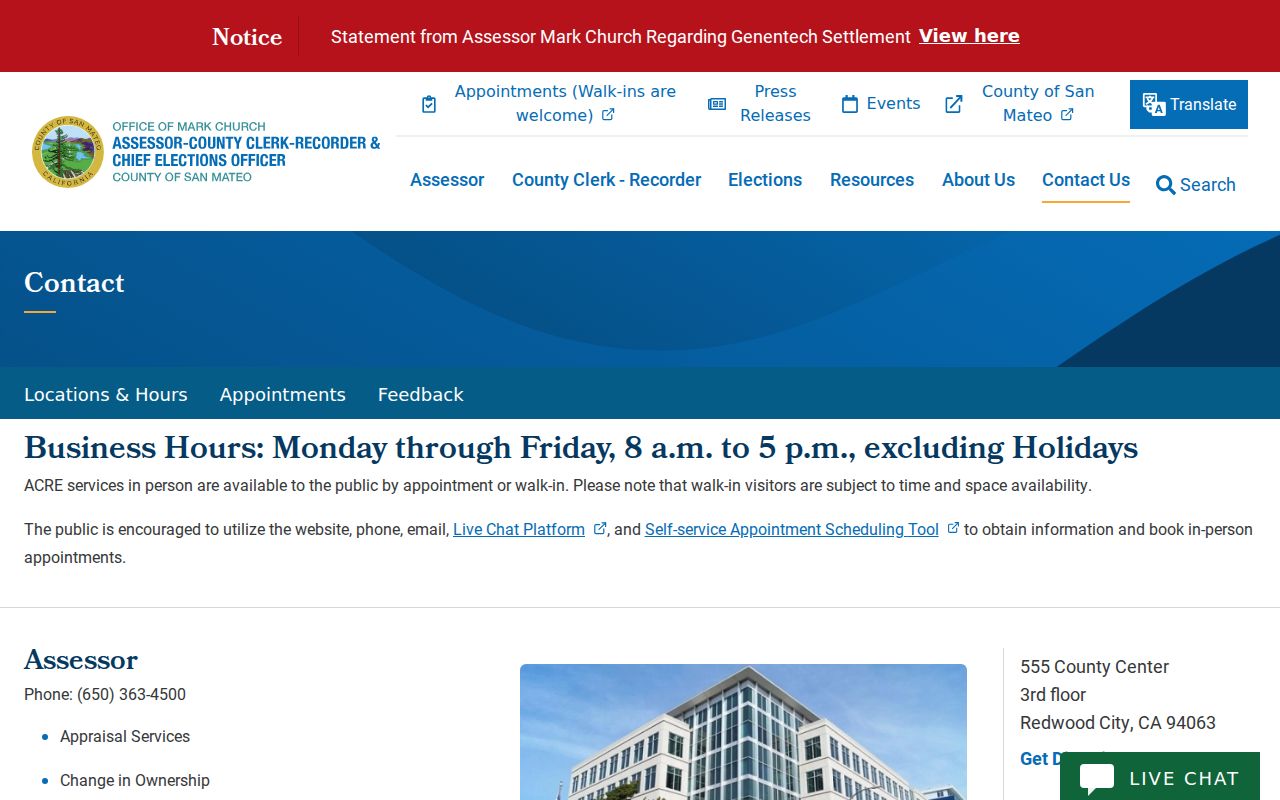
The county contact capture connects the house-history question to the office that can inspect, retrieve, or copy the recorded instrument.
Published fees include $5 for the first page and $1 for each later page of a plain recorded copy, $5 for certification or under-seal service, $2 for a recorded-map copy, and $20 for a research file. Recording surcharges differ by instrument and statute, and the ACRE recording-fee page notes changes effective in January 2025. Confirm the controlling amount before ordering. ACRE cannot choose the instrument needed to change title or give legal advice.
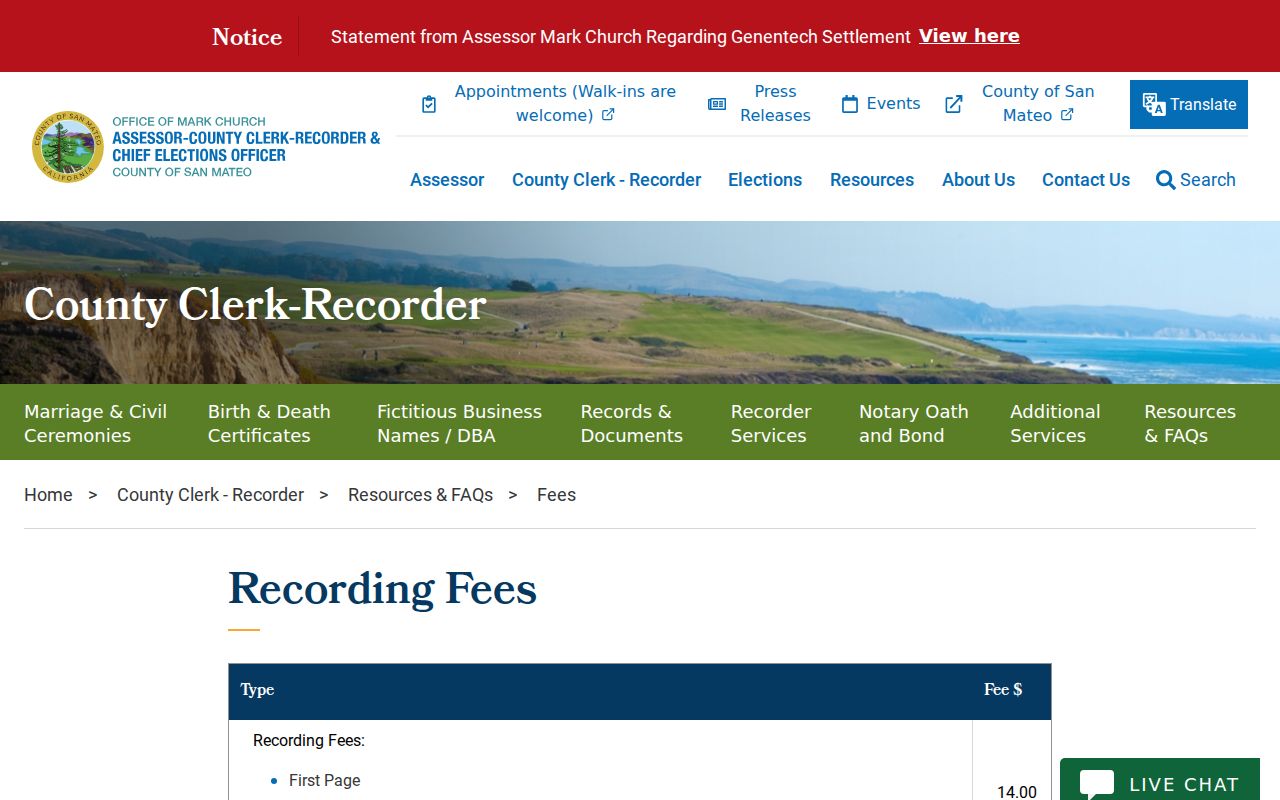
The recorder-fee capture demonstrates why a house-history request should identify the document before quoting a cost. Page count, certification, map, research, and statutory fees are different services.
San Bruno Permits and House History
Title records say who received or conveyed an interest. Permit files can show when a structure changed, who applied, which contractor was named, and how an inspection sequence unfolded. MGO Connect covers current permit and project work from July 1, 2024. Older material is associated with eTRAKiT, OnBase, and the city counter, but the research did not locate an official starting year for the legacy files. Request a date range and APN when an address search is too broad.
The San Bruno History Collection adds Sanborn fire-insurance maps, clipping files, and newspapers. Exact local Sanborn sheet years were not published in the catalog, so treat the maps as a supervised continuity source. A footprint, street name, and lot line can explain why a previous resident appears under a different address. That is stronger than relying on a modern geocoder alone.
Property work and resident work must remain distinct. A named permit applicant may be an owner, agent, or contractor. A house history can mention that role without recasting the person as a household member.
San Bruno Polk Snapshots for Past Households
The library's Polk telephone directories for 1950, 1953, 1955, and 1959 are the clearest local address snapshots. They normally show a subscriber, street address, and telephone number. The catalog does not verify spouse notation, occupation, owner or occupant marks, or a reverse section. A house-history conclusion should quote only the fields visible on the inspected page.
Check all four volumes. A first appearance may bracket an arrival, and a last appearance may bracket a departure, account change, or name change. Previous residents can be bracketed by these dated appearances, but not fully counted from them. Search the San Bruno Herald around the break. Add clipping files, yearbooks, the WWII Honor Roll, Victory War Album, or oral histories when a family connection matters. The directory collections themselves are covered in the San Bruno city directory collections page, while this trail keeps the address as the organizing key.
San Bruno Census Pairing
The 1950 census is the newest public decennial census in 2026 under the 72-year release rule. It can add household relationships, ages, birthplaces, occupations, and residence at enumeration to a telephone listing. The census address may use an older number, a different spelling, or a route description. Match household names and map evidence rather than assuming a modern address tool will resolve the line perfectly.
Use a simple timeline: directory listing, census household, newspaper event, and deed or permit date. If the census contains several people with the same surname, use ages, birthplace, spouse, or child relationships as disambiguators. If a person appears in a directory but not the census, do not force the match. Enumeration timing and listing practice can explain a gap.
San Bruno Address Continuity
Old street labels and modern numbers can hide a continuous property. San Bruno Road is documented in historical-resource research as corresponding to today's San Mateo Avenue. Historical neighborhood terms include San Bruno Park, Belle Air Park, and Lomita Park. The research did not locate an official citywide street-renumbering year, so a house-history search should not invent one.
Use the APN, legal description, subdivision or survey map, Sanborn footprint, and a deed date together. If two sources use different names, preserve both in the notes and identify the map or deed that connects them. The county GIS city and ZIP layers can test the modern location, but an old newspaper, directory, or archive may still require in-person review.
San Bruno Past Household Trail Endpoints
Past occupants often disappear from a title chain but remain in event records. A San Bruno Herald obituary can connect a name to a family, address, or date. Probate filings can identify a decedent, petitioner, and heirs in public portions of a case. A death record or certified copy follows its own eligibility rule; the California death-record application and the birth-record application show the separate request routes. Newspapers and probate are trail endpoints and context sources, not permission to open sealed or confidential material.
Search the Superior Court probate index by name, then confirm the case number and disposition. Pair the result with a known deed or directory date. If a name appears in an obituary but the address is missing, use a library clipping file, map, or recorded instrument to test the connection. This layered method is useful for estate and family-history work because it avoids treating a single notice as a complete biography.
Note: A probate party or obituary subject may explain a household change, but only the source record defines the role and date.
Privacy Limits on San Bruno Previous Residents
A house history can identify recorded owners and listed historical subscribers without naming every person who occupied the property. Household members, unlisted subscribers, protected voters, minors, and people whose records are sealed may not appear. Ownership is not occupancy. Absence from a Polk volume or public index is not proof that a person was absent from the house.
Use public records for a defined family, estate, architectural, or civic question. Do not use a backward address trail to stalk, harass, intimidate, or harm anyone. California confidentiality programs, sealing rules, and redactions exist for a reason. If a public source is wrong, contact its originating custodian rather than trying to expose a protected person through another search.
Lawful house history. Keep the focus on the parcel, documented events, and family research. A house-history record is not a license to track a living person or defeat an address-confidentiality program.