
The San Bruno City Directory Shelf
The strongest local city directory claims come from the San Bruno Public Library's History Collection. The catalog explicitly identifies four Polk telephone directories for San Bruno. It also places those volumes beside newspapers, clipping files, Sanborn maps, school yearbooks, local papers, oral histories, and community scrapbooks. The coverage table distinguishes a directory from the related sources that help interpret it.
| Collection | Years | Where held | Access |
|---|---|---|---|
| Polk telephone directories | 1950, 1953, 1955, 1959 | San Bruno Public Library History Collection | In-library only |
| San Bruno Herald | 1920-2004 | Library digital and local newspaper archive | Runs may be incomplete |
| Clipping files | 1938-2007 | San Bruno Public Library | Subject and date folders, in-library |
| San Bruno Precinct Register | 1908, supplement through July 1909 | Library storage | Controlled Reference Desk access |
| School yearbooks | Varies by school | Library History Collection | In-library; five named school groups |
| Oral histories | Memories reaching the 1800s; recordings from the Bicentennial and 2014 | San Bruno Voices and San Bruno Stories | Digital audio and excerpts |
The four Polk dates are safe local year claims. The catalog does not expose a scanned page, a complete publisher run, or a verified reverse section. That candor matters: a city directory page should describe what can be inspected, not promise fields that have not been seen.
Four San Bruno Polk Directories
The 1950, 1953, 1955, and 1959 Polk volumes are telephone directories, even though a searcher may call them a San Bruno city directory. A typical telephone listing supplies a subscriber name, street address, and telephone number. Business entries may have a category or typographic emphasis. A listing can therefore anchor a name to a street for one moment, while a missing listing can reflect an unlisted number, a different subscriber, or a move.
Do not turn the four dates into a smooth year-by-year series. The gaps are real. Check all available volumes, then search the San Bruno Herald around any first or last appearance. For a younger person, add the relevant school yearbook or The Crest. For a wartime family, compare the WWII Honor Roll and Victory War Album. Those pairings add relationships and context that a telephone listing may lack. The San Bruno History Collection listing is the source for the local Polk-year capture below.
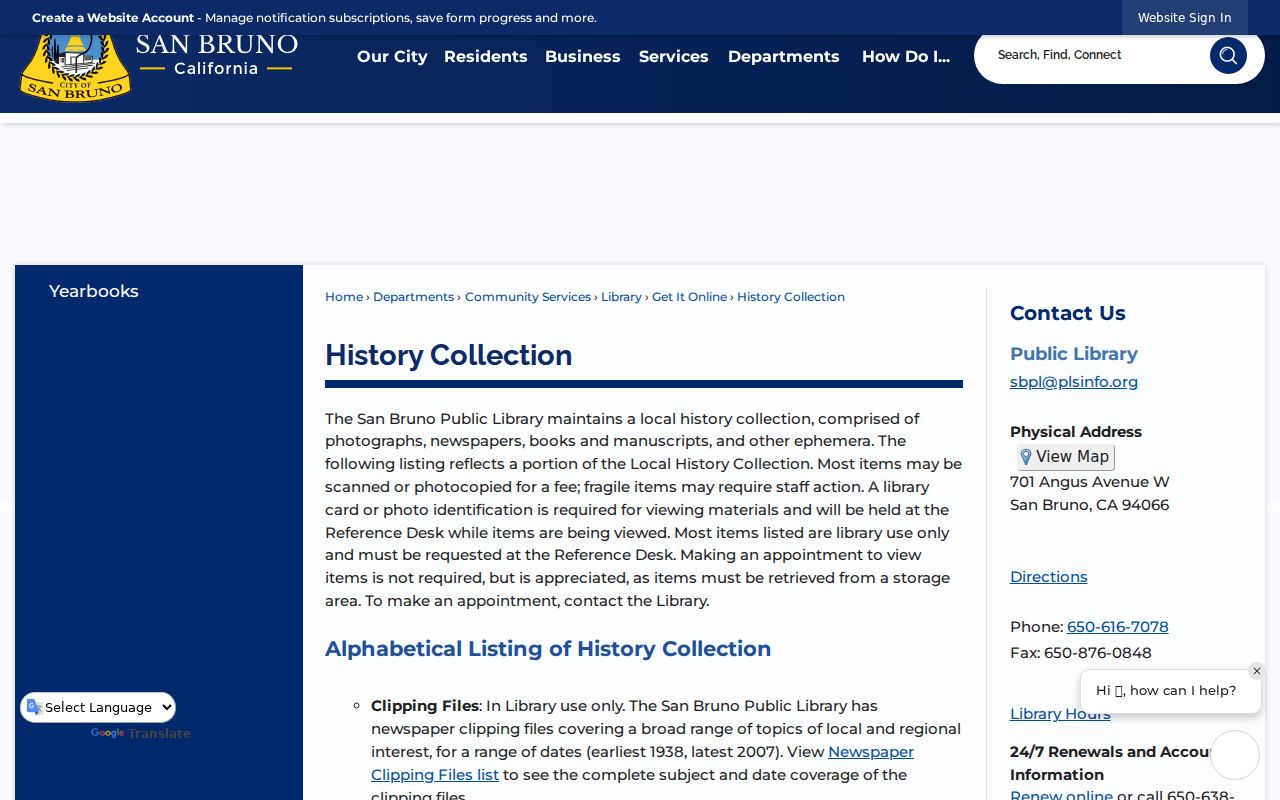
The San Bruno History Collection capture shows the local shelf where the verified Polk years and supporting sources are described. The online catalog is a finding aid, not a digitized page viewer.
What the San Bruno Directory Catalog Confirms
The catalog calls the holdings “Polk Directories” and identifies the four San Bruno years. It does not verify the occupational, spouse, widow, owner, occupant, or reverse-address marks often associated with a classic city directory. An actual entry and abbreviation key require inspection in the library. This is an important research result, not a missing detail to fill with a guess.
| Record clue | Confirmed or unconfirmed |
|---|---|
| Publisher and type | Confirmed as Polk telephone directories in the local catalog. |
| Local years | Confirmed: 1950, 1953, 1955, and 1959. |
| Subscriber and address | Expected in a telephone listing, but inspect a local page before stating the exact format. |
| Spouse or occupant notation | Not verified in the online catalog. |
| Reverse street section | Not verified. Do not promise a criss-cross section without viewing the volume. |
A volume search should record the volume year, page, printed spelling, address, and any mark that actually appears. If a line is unclear, photograph or copy it under the library's rules and ask the Reference Desk about the abbreviation. A later source can then test whether the entry describes a household, a business, or only a telephone subscriber.
- Subscriber
- The person or entity listed for a telephone account. It is not a complete household roster.
- Householder index
- A name-based aid that points to a household or address. The San Bruno catalog does not promise one in the Polk set.
- Abbreviation key
- The publisher's explanation of short marks or symbols. Inspect the volume before assigning a meaning.
- Criss-cross directory
- A reverse arrangement by address or telephone. It may exist in a volume, but the local catalog does not verify it.
San Bruno's Reference Desk Access
Most History Collection material is library use only. The Reference Desk retrieves items from storage, holds a library card or photo ID while the researcher views them, and appreciates an appointment even though one is not mandatory. Most material may be scanned or photocopied for a fee. Fragile material may need staff handling, and copying is controlled by the condition and rights attached to the item.
Ask for several date-adjacent items at once. A 1955 Polk volume, the Herald issue around a move or death, and a related clipping file can answer more than one isolated listing. Give the librarian a surname, street, date range, and any alternate spelling. The local San Bruno Library service gateway is the route for hours and general contact details, while the History Collection page identifies the actual materials. The California Revealed collection host is the source for the digital-history capture below.
The California Revealed capture represents a digital history channel that may complement the library shelf. It should not be treated as proof that every Polk page is digitized or searchable by name.
Note: Storage retrieval and supervised copying are part of the access method, not obstacles to be skipped when researching a local volume.
San Bruno's 1908 Precinct Register
Long before the four Polk volumes, the library preserved a sealed San Bruno Precinct Register containing 1908 voter-registration affidavits. A supplement continues after registration closed through July 1909. It is a rare historical resident snapshot because an affidavit can connect a name, address, and registration moment in a controlled setting. The book is not a modern voter-file substitute, and its sealed status means the Reference Desk controls access.
Use the precinct book as one point in an address or family trail. Pair a spelling with a newspaper notice, a deed, a map, or a later directory. The difference between a sworn historical affidavit and a current self-authenticated voter lookup explains why San Bruno city directory research has to respect both archival practice and modern election safeguards. The California State Archives gateway is the source for the broader archive capture below.
The California State Archives capture shows a broader historical-records gateway for records that extend beyond the San Bruno library shelves. Search it as a state archive, not as a replacement for the local catalog.
San Bruno's Companion Sources
The San Bruno Herald runs from 1920 through 2004, though the library warns that runs may be incomplete. Digital and local newspaper files can reveal an address change, obituary, property notice, social event, or business relationship. Clipping files cover local and regional subjects from 1938 through 2007. These sources are often better for the event that explains a directory change than for a complete list of residents.
Five named school groups expand the historical trail: Belle Air Elementary, Capuchino High, Crestmoor High, Engvall Intermediate, and Parkside Intermediate. Exact year coverage varies. The Crest covers Crestmoor High from 1962-1969. PTA, garden-club, USO, Community Center, and other scrapbooks can identify voluntary civic networks that never appeared in a formal directory. Oral histories in San Bruno Voices and San Bruno Stories carry memories reaching into the nineteenth century, with recordings from the Bicentennial and 2014.
For a family-history question, use a printed listing as the address key, a school source for age or class context, and a newspaper for an event. Do not infer ethnicity from a surname, especially in a multilingual city with many naming traditions. The San Mateo County Historical Association gateway is the source for the regional-holdings capture below.
Regional fallbacks add breadth without changing the local claim. The California State Library's San Mateo research guide advises searching both its City Directory and Telephone Book databases with “San Mateo” and “San Bruno.” San Mateo Main Library's California Collection offers county-area directories, historical and Sanborn maps, microfilm newspapers, and local-history references. FamilySearch also holds San Mateo County images from 1851-1991, but only marriage intentions are indexed and image access can require login or an affiliate site.
Trace a San Bruno City Directory Household
A local volume set is most useful when its gaps are made explicit. The first and last listing can bracket a period, while the 1950 census supplies household relationships, ages, birthplaces, occupations, and residence at enumeration. The census is released under a 72-year rule, so 1950 is the newest public decennial schedule in 2026. Address spelling and numbering still need map and parcel checks.
- Write down the exact name, address, telephone number, and volume year from each Polk page.
- Compare 1950 with the released census and note relationships, ages, birthplace, and occupation without treating the census address as a perfect modern geocode.
- Search the Herald and clipping files before and after a first or last directory appearance for notices that explain the change.
- Use school yearbooks, the Honor Roll, or oral histories when a young person, service member, or community group is part of the question.
- Bridge the address to deeds, APN, Sanborn maps, and permits when a street label or number differs across decades.
For modern confirmation, a directory find can be handed to a separate one-person records workflow. For a current parcel chain, the San Bruno street directory page owns the APN, deed, permit, and map mechanics so the historical shelf remains focused on collections.
San Bruno City Directory Through Tanforan
Local directories become more meaningful when the city's physical changes are part of the reading. San Bruno grew beside the railroad after 1863, incorporated in 1914, and changed again as Tanforan moved from a racetrack to aviation, wartime assembly-center, military, and later commercial uses. Downtown and rail-grid growth after 1906, Mills Park in the late 1940s and 1950s, western hills through the 1960s and 1970s, Bayhill and Tanforan commercial growth from the 1970s, and The Crossing after 2000 create different address contexts.
A directory entry can therefore point to a neighborhood era rather than a timeless place. Use the printed street, a Sanborn sheet where available, the APN, and newspaper language together. Historical names such as San Bruno Park, Belle Air Park, Lomita Park, and the former San Bruno Road can otherwise make a correct household look like a false match.
| Year or era | Record-keeping context |
|---|---|
| 1863 | The railroad arrived, creating an early transportation and settlement anchor. |
| 1914 | San Bruno incorporated, while library holdings continue to preserve earlier local evidence. |
| 1920-2004 | The San Bruno Herald carries names, notices, and address clues across changing neighborhoods. |
| 1950-1959 | Four verified Polk telephone-directory snapshots provide listed-subscriber dates. |
| 1985 onward | RecorderWorks supplies the current party-name index boundary for recorded instruments. |
The San Mateo County Historical Association capture is a county-level archive gateway. Its research copies and finding aids are a fallback when a local catalog points to a wider historical resource.
San Bruno City Directory Limits
A San Bruno city directory can show a listed subscriber at an address in a given volume. It cannot establish every person who lived there, prove title, or replace a certified vital record. A missing listing does not prove absence. A telephone number does not prove the subscriber's relationship to the property. A newspaper notice may report an event without supplying a complete legal record.
When the city directory trail reaches a modern question, move to the correct custodian. Use county GIS and deeds for land, San Bruno permits for municipal work, the Superior Court for case files, ACRE or CDPH for vital-copy rules, and California's official programs for protected or sealed records. The shelf is powerful because it supplies time and context. It is reliable only when the conclusion stays within the fields the page actually shows.