
What San Bruno Resident Lookup Confirms
There is no single name index for San Bruno residents. Each record type confirms a narrower proposition. The coverage table puts those propositions side by side so a name search does not outrun its source. A result should be quoted as a deed party, court party, voter record, permit applicant, license holder, heir, or directory subscriber rather than as a universal statement about the person.
| Record | What it confirms | Where to search | Access |
|---|---|---|---|
| Deed index | Recorded title transaction, parties, date, and legal description | RecorderWorks and Recorder counter | 1985 name index; earlier name work at counter |
| Assessor information | Assessment, ownership and mailing context tied to a parcel | ACRE and county property gateway | Portal or office inquiry; not occupancy proof |
| Superior Court index | Case number, party role, category, filing date, and permitted docket detail | MIDX and Records Management | Free index with remote and sealing limits |
| Vital record route | Birth, death, marriage, or divorce event clues | ACRE, CDPH, or Superior Court | Copy type and eligibility control access |
| Business and license tools | Entity, agent, license status, dates, and public discipline links | bizfile, DCA, CSLB, or ABC | Free search; copies may differ |
| Probate and obituary sources | Decedent, petitioner, heirs, family, or event context | Superior Court, library, newspapers | Public portions and supervised collections |
Start with the narrowest fact in hand. An APN is strong for a land question. A case number is strong for a court question. An event date and county are strong for a vital-record application. A school and approximate year can make a local yearbook more useful than a broad web query. A resident lookup becomes an evidence trail when the search term and the record purpose match.
Choose the San Bruno Record Question
For a current address clue, begin with the county GIS and assessor route, then distinguish mailing address from situs. For a title event, use the Recorder's party index and the legal description. For a case timeline, use the Superior Court index and preserve the case number. For a family-history event, search the library's San Bruno Herald, clipping files, yearbooks, and obituary leads before ordering a certified copy.
For a professional or business affiliation, state tools are more direct. California bizfile Online can search by business name or entity number and expose status, jurisdiction, addresses, agent, and filing images. The California Department of Consumer Affairs license search can search board, license type, name, number, city, county, status, and discipline. These results describe an official filing or license. They do not establish a private address or a complete biography.
The bizfile capture shows an official affiliation route. Refine a common name with an entity number, filing date, city, or role before treating a result as the same person.
Search San Bruno RecorderWorks
RecorderWorks supplies a real name-search workflow for recorded instruments. Select the party type, enter a surname or a partial name, and set From and To dates in MM/DD/YYYY format. The portal says name indexing is online from 1985. A known document number, book and page, recording date, or document type can narrow the result. Type filters include deeds, deeds of trust, mortgages, leases, assignments, easements, liens, releases, judgments, court orders, divorce decrees, distributions, death affidavits, maps, and other instruments.
The public display suppresses property-owner names for identity-theft protection. A current San Bruno resident lookup may therefore need a known identifier, counter inspection, email, or copy request. Search a name as a clue, then read the document's parties, role, recording date, legal description, and later release or reconveyance. A recorded grantee is not automatically the present occupant.
Note: The 1985 name-index boundary is a search boundary, not the beginning of San Bruno's recorded property history.
San Bruno Court Index Limits
San Mateo Superior Court serves San Bruno and covers civil, criminal, family, probate, small claims, traffic, and other divisions. The public MIDX index supports case-name and case-number routes, with separate traffic handling. Records Management is at Hall of Justice and Records, 400 County Center, First Floor, Room A, Redwood City, with a public counter, computers, mail-copy route, and staff retrieval for older or off-site files. The exact remote view depends on case type, role, sealing, and the California Rules of Court remote-access rule.
| MIDX search field | Type and validation |
|---|---|
| Case number | At least five alphanumeric characters; the most precise route when known. |
| First and last name | At least two characters in each field; a suffix wildcard can handle variants. |
| Business name | At least three characters; refine broad results before assuming an affiliation. |
| Filing date range | From and To dates with a maximum five-calendar-day interval. |
| Case type | Index categories such as civil, criminal, family, probate, and small claims. |
The San Mateo public index is the source for the case-search capture below. Record the case number, party role, filing date, and disposition path before moving to the file. Federal matters use PACER, a separate court-record route with its own fee schedule.
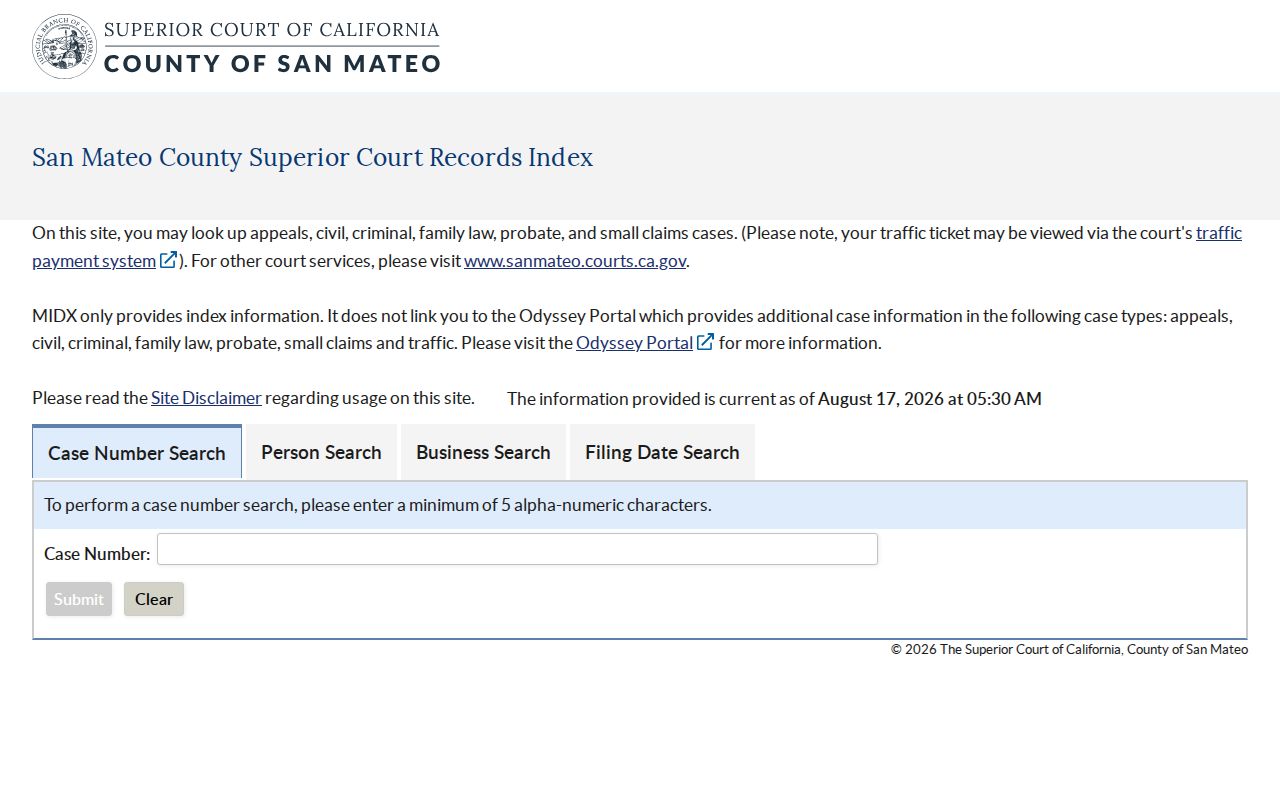
The San Mateo public index capture shows the name and date routes.
- A public index can return case number, case title or party names, category, and filing date.
- A docket entry is a recorded event, not a judgment or proof of guilt.
- Remote access is narrower for criminal, family, juvenile, mental-health, adoption, sealed, and confidential matters.
- Records Management can provide permitted copies, but it does not conduct open-ended research for a requester.
Verify San Bruno Resident Records
A careful resident lookup uses at least two independent anchors. A common name in a deed and court index is not enough. Add a middle initial, spouse or co-party, event date, APN, known school, license number, entity number, or matching legal description. The aim is not to collect every possible hit. It is to show why two records refer to the same person or why the match remains uncertain.
- Normalize the name, including initials, hyphens, spelling variants, and any known former name.
- Anchor it to a San Bruno parcel, court case, school year, business filing, or event date.
- Run the relevant official index and save the record number, date, role, and source URL.
- Check a second custodian, then order a certified or informational copy only when its eligibility fits the question.
- Write the conclusion narrowly: “named party in a recorded instrument” is different from “current resident.”
- Docket
- A court's running record of filings, hearings, orders, and other case events.
- Index versus image
- An index points to a record. An image or file contains the document itself, if access is allowed.
- Certified copy
- A custodian-attested copy accepted for the purpose defined by the issuing law or agency.
- Informational copy
- A vital-record copy marked as informational and not usable to establish identity.
San Bruno Vital Copy Rules
California vital access depends on the record and the copy type. San Mateo County ACRE and the CDPH Vital Records program can issue birth, death, and marriage copies through their own channels. Health and Safety Code sections 103525-103526 distinguish authorized and informational certified copies. An informational copy can be generally available with a legend, but it cannot establish identity. Confidential marriage copies are restricted to spouses or a court order. Adoption files and original birth certificates remain sealed under Family Code section 9200 and related law.
CDPH applications ask for the record type, name, event date and place, county, parents or spouses where relevant, applicant identity and contact details, relationship or purpose, copy type, eligibility, signature, and payment. The 2026 state fee schedule lists $31 for birth, $26 for death, $19 for public marriage, and $18 for a divorce certificate of record. County tables can differ from stale PDFs, so confirm the current county or state route before mailing a payment. A failed search can produce a Certificate of No Public Record while retaining the search fee.
Divorce research needs special care. The Superior Court holds the judgment and file. CDPH's certificate of record is a limited abstract for specified years, not the pleadings or order. A vital index can suggest a spouse, parent, or death event, but a certified copy is a separate access decision.
Two Anchors for a San Bruno Match
Same-name errors are common when a search crosses deeds, court files, licenses, and newspapers. Use a date and a place, then seek one more independent marker. An APN and legal description can distinguish two title parties. A spouse or co-party can separate two court results. A school and year can separate two people in a local collection. A business entity number or license number can prevent a broad name match from becoming a false identity.
Do not ask a clerk to identify the “right” stranger. Ask about the record's access rule, copy procedure, or case number. If a result is wrong, correct the originating record with the court, assessor, recorder, elections office, licensing board, or business custodian. Removing a duplicate from a private compilation does not repair an official source or explain why a match was wrong.
Request a San Bruno Resident Record
When an online index stops short, use the custodian's written route instead of asking a search provider to fill the gap. The San Bruno Public Records Request process asks for the department, a description of an existing record, a date range, and the preferred format or inspection method. Add an address, APN, permit number, case number, or document number when one is known.
Under the California Public Records Act, Government Code sections 7920.000-7931.000, an agency normally determines within ten calendar days whether disclosable responsive records exist, with a possible fourteen-day extension for unusual circumstances. That period is not a guaranteed production deadline. Exempt material can be withheld or redacted while segregable portions are released. County ACRE, Superior Court Records Management, CDPH, Elections, and the library each use their own request or counter procedure.
San Bruno Heirs, Classmates, and Parents
Specific human uses call for specific records. An heir search can pair probate petitions or decrees with obituaries, deeds, and the San Bruno Herald. A former classmate search can use yearbooks from Belle Air Elementary, Capuchino High, Crestmoor High, Engvall Intermediate, or Parkside Intermediate, with The Crest for 1962-1969. The WWII Honor Roll and Victory War Album provide names, addresses, and family members for a local service-history trail. A county custody question can use the San Mateo Sheriff inmate locator; state custody uses the separate CDCR incarcerated-person locator, not a general resident list.
Birth-parent or adoptee research belongs with California's official CDPH and court adoption processes. Public birth-file guessing cannot open a sealed original certificate. The same rule applies to confidential marriage records and protected addresses. A useful resident lookup makes the official route part of the answer instead of trying to work around it.
The library's supervised storage, ID hold, and controlled copying rules apply to these human-history sources. A respectful search records only what the collection shows and leaves private or protected information alone.
San Bruno Business and License Links
California's official business and license tools can verify a public affiliation without turning a person into a general resident profile. bizfile Online searches an entity name or number, with advanced filters for type, status, date, and public-company fields. Results can show entity number, status, jurisdiction, addresses, agent, and filing images. The service limits broad results and does not promise phone, email, ownership, or subsidiary details.
The Department of Consumer Affairs search covers board, license type, number, name, city, county, status, and discipline. CSLB and ABC add contractor or alcohol-license routes. San Bruno business tax certificates do not have a verified public name-and-address search; a focused Finance inquiry or CPRA request is the safer local path. State records establish an entity or license status, not a person's home address.
California Voter Data for San Bruno
My Voter Status is an authenticated self-lookup. It returns registration status and address, party and language preference, ballot status, polling place, election information, and county contact for the voter who completes the match. It does not let an anonymous user search a San Bruno street. A qualified statewide or county file request requires a declared election, scholarly, journalistic, political, or governmental purpose, identity and supporting documents, a security plan, payment, and restrictions on handling.
Statewide instructions describe $100 access for the full file and $30 for a specific-voter request, capped at $100. San Mateo County publishes a $125 electronic file and a printed-list price per 1,000 voters. Elections Code sections 2188, 2194, and 18109, along with the regulations, prohibit casual personal or commercial use, solicitation, and harassment. Protected and confidential records are excluded.
San Bruno DROP and Safe at Home
California's DROP system opened January 1, 2026, for one free deletion or opt-out request to more than 600 registered data brokers. A verified California resident can choose identifiers such as names, email addresses, phones, date of birth, ZIP, device IDs, or VIN. Brokers begin processing on August 1, 2026, check at least every 45 days, and delete matched nonexempt data under the statutory process. The DROP requirements explain the state process. The California Controller's Unclaimed Property search is the source for the official name-search capture below.
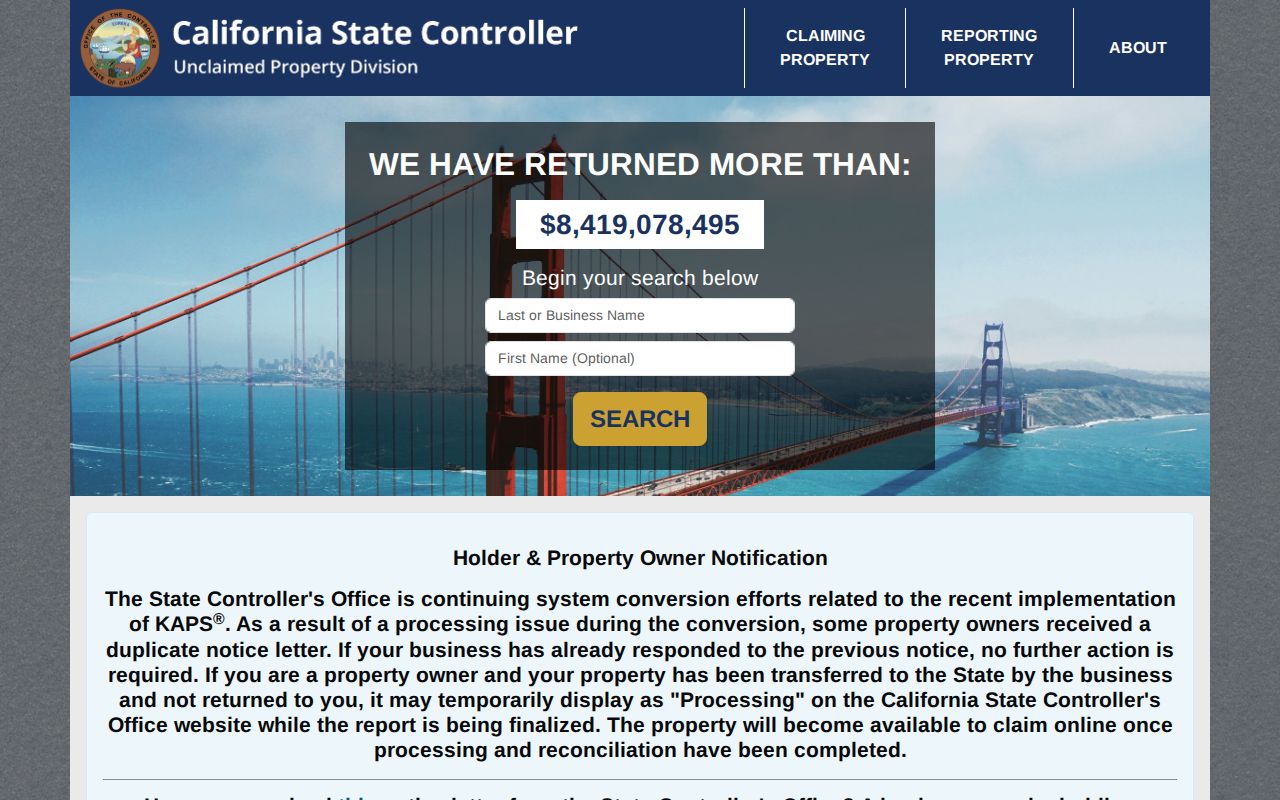
The California Controller's Unclaimed Property capture is a useful example of a free official name route. It may help find a property claim lead, but DROP does not erase deeds, assessor records, court files, or other government records that remain public by law.
Safe at Home provides a substitute address, mail forwarding, confidential voting, and agency or court use for eligible victims and threatened public workers. A deed's legal description can still reveal a property's location, so a participant should use program-specific advice before drawing a property conclusion. The absence of a public address may be a safety feature, not a missing record.
Legal Limits on San Bruno Resident Lookup
A San Bruno resident lookup is for personal, lawful research. California Penal Code section 646.9 addresses stalking, and section 653.2 addresses malicious electronic distribution of identifying information intended to cause unwanted contact, injury, or harassment. Voter-data misuse has separate election penalties. DMV address information is protected under the federal Driver's Privacy Protection Act. Sealed, juvenile, adoption, confidential, and protected records stay out of an ordinary name search.
Commercial people-search compilations can merge stale public and licensed inputs, but they do not change the access rule or make a weak match official. Use them only as an unverified lead, never as the final source, and never to pursue a person who has not consented to contact. The originating custodian is the place to verify a record, request a permitted copy, or report an error.
Lawful use. Use a resident lookup for family history, reconnecting, civic transparency, or a documented record question. Do not stalk, harass, intimidate, or harm any person, and do not try to defeat a confidentiality program.